
Get Your Free Estimate Now
"*" indicates required fields






Moving into a Class A, Class-AAA, or premium office tower in downtown Vancouver is more than a new address. For a growing business, it can be a major step.
However, these buildings bring rules that standard office moves often do not have. Your team may need to book the freight elevator, loading dock, and approved move hours early.
Property managers may also ask for insurance documents, floor protection, security access, and vendor details. Because of this, access planning can matter as much as the furniture move.
If your team leaves these steps too late, the move can slow down fast. The crew may wait for elevator release, dock access, or security approval.
Meanwhile, your IT setup, staff return, and first-day schedule may fall behind.
This guide shows how to plan the timeline, approvals, responsibilities, and move-day order. The goal is simple: help your team restart work without unnecessary confusion.
What Does a Class-AAA Office Move Mean?
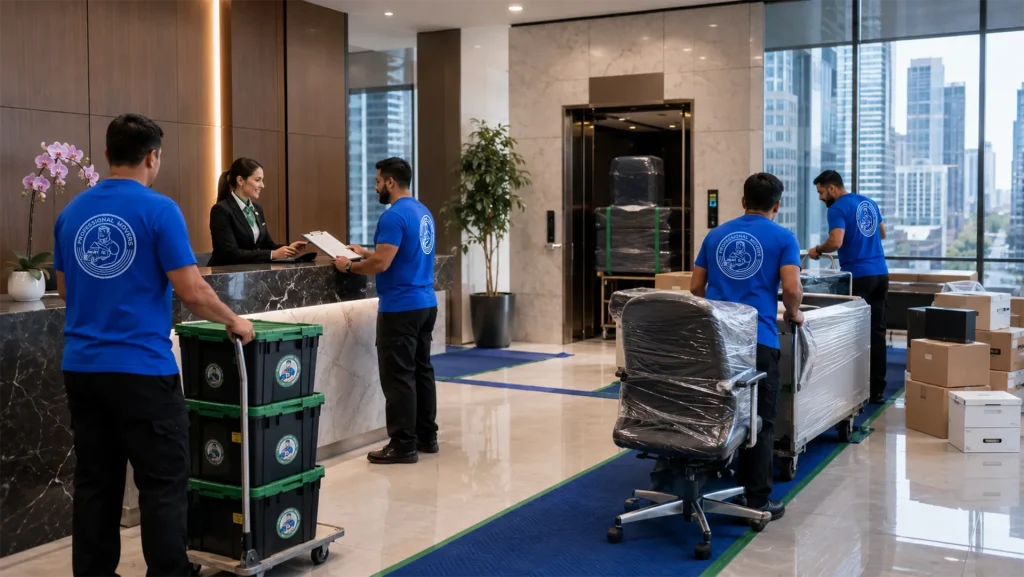
A Class-AAA office move means relocating to or from a premium commercial building, where access is more controlled than in a standard office property. In downtown Vancouver, this often includes freight elevator bookings, loading dock time windows, Certificate of Insurance approval, after-hours access, security check-ins, floor protection, and coordination with property management before movers arrive. These same planning issues can also apply to many Class A, high-rise, and premium office tower relocations.
Quick Answer: How to Plan an Office Move
A Class-AAA, Class A, or premium office tower move in Vancouver should be planned around three things: building access, business continuity, and first-day readiness. Before moving day, confirm freight elevator bookings, loading dock windows, insurance documents, security procedures, IT vendor access, and department priorities. The move should be scheduled and sequenced so the new office is ready for staff, clients, and daily operations as soon as possible.
Who This Guide Is For
This article is written for office managers, operations leads, founders, HR teams, tenant coordinators, facilities teams, and business owners who are responsible for a managed downtown Vancouver office move. It is especially useful when the relocation involves building approvals, freight elevator bookings, loading dock timing, IT coordination, employee communication, and first-day office readiness
Planning Input from Our BC Operations Manager
Mr. Rameet Singh, our BC Operations Manager, reviewed the planning points in this article from an operations perspective. His work includes crew scheduling, access timing, customer updates, and on-site issue handling for residential and commercial relocations across British Columbia. His input helps explain where Vancouver office moves can slow down, especially when approvals, elevator timing, security access, or IT setup are not confirmed early.
Moving Into a Premium Vancouver Office Tower?
Get a commercial moving quote built around your building requirements, business schedule, and office restart priorities.
Why a Class-AAA Office Move Is Not Like a Regular Office Move
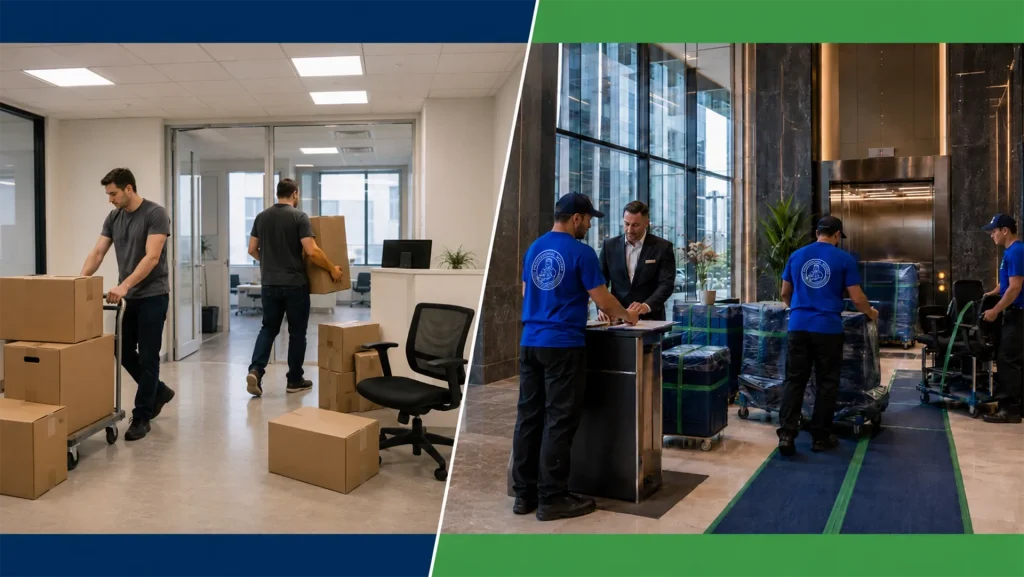
Many businesses see an office move as furniture going from one address to another. In a Class-AAA Vancouver tower, the harder part is fitting the move into the building schedule and the company’s workday.
If your team waits too long to plan access, problems can start early. The crew may wait for elevator time, loading dock access, or building approval before the office is ready.
Building Management Controls More Than You Expect
Premium office towers usually have clear move-in and move-out rules. These may include certificate of insurance requirements, approved move hours, floor protection, elevator padding, waste removal rules, and contact details for the move-day supervisor. If these details are not confirmed early, the move can be delayed before the first item is loaded.
Your Moving Date May Depend on Building Access
A preferred moving date does not always mean the building can support it. Other tenants, contractors, or deliveries may already book freight elevators, loading docks, and service corridors. In busy downtown Vancouver buildings, evening or weekend access may also be required to avoid disrupting regular business hours.
On some downtown Vancouver office moves, the moving crew may be ready before the loading dock is released or the freight elevator is available. That is why the move-day building contact, elevator window, loading dock time, and security approval should be confirmed in writing before the truck arrives.
More People Are Involved Than Most Teams Expect
A Class-AAA office move usually involves more than the moving company. Property managers, security staff, IT vendors, department leads, building engineers, cleaners, and internal decision-makers may all have a role. When one group is not updated, small issues can lead to missed access windows, wait time, or a delayed office restart.
The biggest challenge is not moving office furniture quickly. It is about coordinating people, establishing rules, and setting business priorities before moving day. Once those pieces are clear, the physical move becomes much easier to manage.
Questions to Ask Your Property Manager Before You Confirm a Moving Date
Before you lock in a moving date, speak with your property manager or building representative. The answers to these questions can affect your moving schedule, truck access, IT setup, and even whether your move can go ahead as planned.
When can moving trucks use the loading dock?
Some Class-AAA buildings allow moves only during specific hours, while others require booking. Confirm the available time window so your moving schedule matches the building’s access rules.
How far in advance should the freight elevator be booked?
Multiple tenants, contractors, and deliveries often share freight elevators. Booking late could mean moving on a different day or waiting for the next available slot.
Is the move restricted to evenings or weekends?
Many premium office towers limit moves during normal business hours to reduce disruption for other tenants. Confirm whether after-hours or weekend access is required before choosing your moving date.
What insurance documents must be submitted?
Ask whether the building requires a Certificate of Insurance (COI), minimum liability coverage, or any additional documents before movers can access the property.
Who is the move-day building contact?
This matters because on moving day, someone may need to approve access, release elevators, coordinate security, or answer issues quickly. Without a named building contact, the mover or office manager may waste time trying to reach the right person.
Will other contractors be working in the building?
Check whether construction crews, furniture installers, maintenance teams, or other tenants have booked the loading dock or freight elevator on the same day. Shared access can affect your moving schedule.
Are there move deposits or refundable damage deposits?
Some buildings ask tenants to pay a deposit before moving in or out. Confirm the amount, payment process, and the conditions for getting the deposit back.
Are there restrictions on oversized furniture or equipment?
Large boardroom tables, server racks, safes, and other oversized items may need a different access route or special approval. It is better to identify these items before moving day than to discover a problem at the loading dock.
What should be confirmed before a Class A office move?
Before a Class A office move in Vancouver, confirm loading dock access, freight elevator booking time, approved move hours, Certificate of Insurance requirements, floor protection rules, move-day building contact, security access, IT vendor timing, and department restart priorities.
Corporate Office Relocation Timeline: From 90 Days Before the Move to Opening Day
Lease signing, office design, and furniture planning often start earlier. This 90-day timeline focuses on the final planning stage, when building access, movers, IT, staff communication, and move-day approvals need to line up.
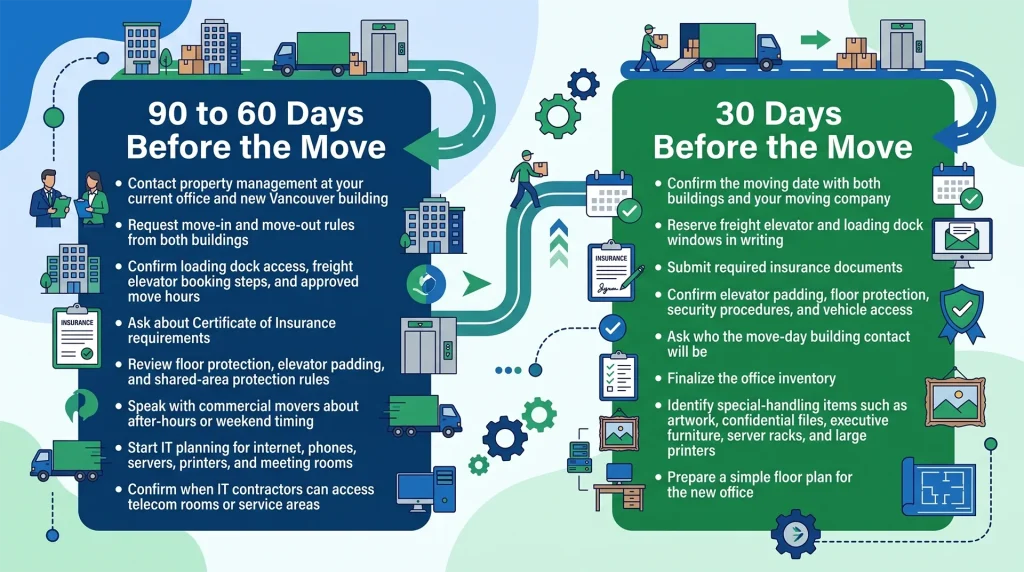
2 Weeks Before the Move
Use this stage to prepare employees, departments, and IT vendors.
- Confirm IT vendor timing
- Share department packing duties
- Send staff instructions for packing personal and work items
- Create a move-day contact list
- Label workstations, private offices, boardrooms, storage areas, and shared equipment
- Use a numbering system that matches the new floor plan
- Start packing non-essential files, supplies, marketing material, and storage items
- Keep daily-use items separate until the final packing stage
- Confirm when access cards will be active for staff, movers, and vendors
- The main goal at this stage is to reduce confusion before moving week begins.
1 Week Before the Move
- Use this stage for the final readiness check.
- Confirm arrival times with the moving company
- Reconfirm after-hours access, freight elevator release time, and loading dock timing
- Review the move plan with your internal move lead, IT vendor, and building contact
- Confirm who should be called if access is delayed
- Remind employees what to pack, what to take home, and what to leave for the movers
- Clear confidential material, personal items, and daily-use supplies
- Check whether cleaners, contractors, furniture installers, or IT vendors are scheduled at the same time
The main goal at this stage is to prevent hallway congestion, blocked service areas, and last-minute access issues.
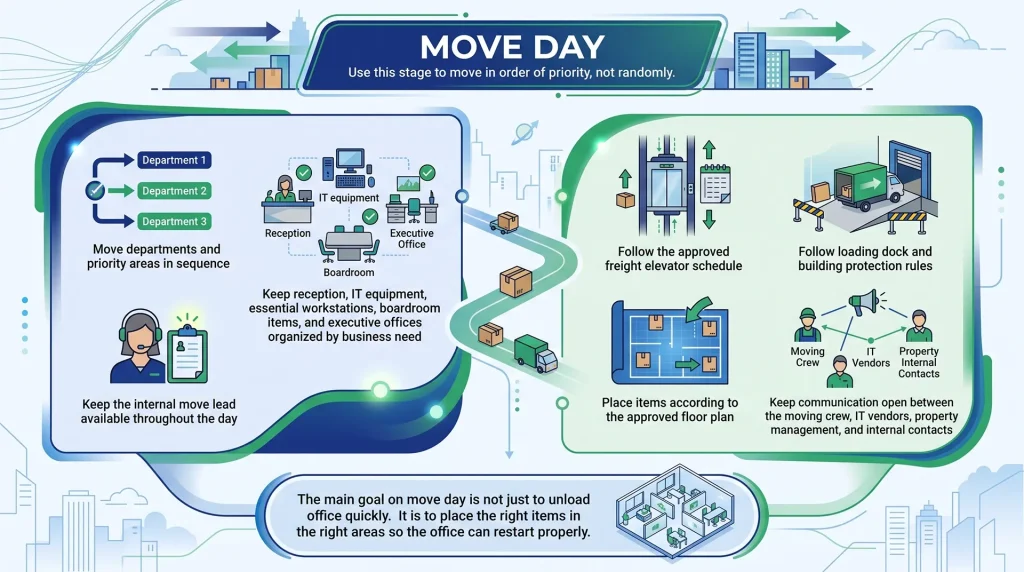
First Business Day After the Move
Use this stage to confirm the office is ready before normal operations resume.
- Test internet and Wi-Fi
- Confirm phones are working
- Check printers and shared equipment
- Test meeting room technology
- Confirm access cards are active
- Walk through reception, workstations, boardrooms, and executive offices
- Complete final furniture adjustments
- Resolve any setup, access, or building issues early
The main goal on the first business day is to help employees return to work without unnecessary downtime.
How to Prepare Your Business for a Class-AAA Office Move
Once your moving date and building requirements are confirmed, the focus shifts inside your business. Employees need clear instructions, IT teams need access and timing, and department leads need to know what should move first, last, or separately. This preparation helps the new office feel ready for work, rather than half-set up when staff arrive.

Assign Internal Responsibilities Before Move Planning
Many businesses expect the moving company to manage the entire relocation. In reality, the moving company handles the physical move, while your internal team keeps the business running.
Assign responsibilities early so everyone knows what they own.
| Responsibility | Primary Owner |
|---|---|
| Overall move coordination | Operations or Office Manager |
| Network, internet, phones and servers | IT Team |
| Employee communication | HR |
| Department packing | Department Managers |
| Building access and approvals | Property Management |
| Physical relocation | Commercial Moving Company |
When responsibilities are clear, decisions are made faster, and problems are easier to solve on moving day.
Plan Around Business Continuity, Not Moving Day
Instead of asking,
“When are we moving?”
Ask,
“When does the business need to be fully operational again?”
That answer should guide every moving decision.
Identify which departments must be available first after the move. For many businesses, this includes reception, customer service, finance, executive offices, and teams that deal directly with clients.
If some employees can work remotely during the relocation, decide this early and communicate the plan before moving week. Reducing the number of people on-site can make the transition easier while giving IT and the moving crew more space to work.
The goal is not simply to finish the move. The goal is to help your business return to normal as quickly as possible.
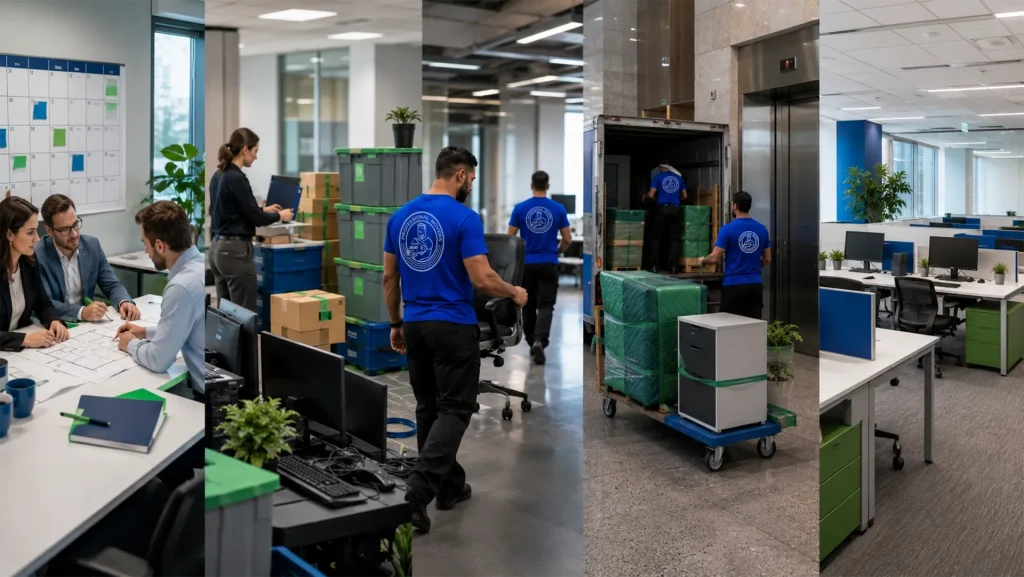
Decide What Moves First, Last and Separately
Not everything should be loaded onto the truck in the same order.
Plan the move based on business priorities rather than office locations.
Move First
These items help your business resume operations.
- Network equipment
- Servers
- Internet and communications hardware
- Reception furniture
- Essential employee workstations
If your network is not ready, many other parts of the office cannot operate properly.
Example: For a 35-person office moving from a downtown Vancouver tower, the IT room may need to be moved before general desks. This gives the IT provider time to test internet, phones, printers, meeting room screens, and shared systems before employees return to the new office.
Move Last
- Items that are not immediately needed can usually be loaded later.
- Archive storage
- Seasonal supplies
- Marketing displays
- Extra furniture
- Long-term storage items
Separate Handling
Some items require additional planning due to their value, size, or sensitivity.
- Confidential files
- Artwork
- Executive furniture
- High-value equipment
- Large boardroom tables
- Server racks and specialized equipment
Identifying these items before moving day helps avoid delays during truck loading.
Prepare the New Office Before the First Employee Arrives
Many office moves are considered complete once everything has been unloaded.
In reality, the move is only successful when employees can begin working without unnecessary disruption.
Before your team returns, confirm that:
- Internet and Wi-Fi are working
- Phones are connected
- Printers are available
- Meeting room technology has been tested
- Access cards are active
- Reception is ready to welcome visitors
- Company signage has been installed
- Kitchen and shared staff areas are ready to use
Walking through the office before employees arrive gives you time to identify small issues before they become larger disruptions during the first business day.
How Professional Movers Vancouver Supports a Commercial Office Relocation
For a Class A, Class-AAA, or premium office tower relocation, Professional Movers Vancouver starts by reviewing the building instructions, move schedule, office inventory, and business restart priorities. This helps shape a flexible plan that fits the property requirements and your team’s return-to-work needs.
The move is then organized by sequence rather than by furniture volume alone. Priority areas such as IT equipment, reception, executive offices, boardrooms, confidential files, and essential workstations can be identified before moving day so they are handled and placed with purpose.
During the relocation, the crew follows the approved move plan while staying connected with your internal move lead and on-site contacts. This helps keep the move organized, reduces confusion about placement, and gives your team a clearer path to restarting in the new office.
Moving Into a Premium Vancouver Office Tower?
Call Professional Movers Vancouver at +1 604-636-8080 to request a commercial moving quote based on your building requirements, move schedule, and office restart priorities.
Common Questions About Office Moves
What is the cost to move an office in Vancouver?
Most office moves in Vancouver typically cost between $600 and $4,000, depending on the office size, furniture volume, building access, crew size, and moving schedule. Larger offices or Class-AAA buildings with stricter access requirements may increase the overall cost.
Can office moves be completed after business hours or on weekends?
Yes. Many Class-AAA office buildings prefer or require evening or weekend moves to reduce disruption for other tenants. Always confirm the building’s approved moving hours with property management before booking your move.
How are confidential files and sensitive office equipment protected during the move?
Confidential files, servers, and other sensitive equipment should be clearly identified before moving day and handled separately from general office furniture. A planned loading sequence and proper handling help reduce the risk of loss, damage, or misplacement.
Should our IT provider be involved before the movers arrive?
Yes. Your IT provider should plan the network, internet, phones, servers, and workstation setup before moving day so essential systems are ready when equipment arrives. Early coordination also helps avoid unnecessary business downtime after the move.
Do high-rise office moves in Vancouver need special planning?
Yes. High-rise office moves in Vancouver often require freight elevator bookings, loading dock access, security approval, floor protection, and after-hours scheduling. These details should be confirmed with property management before the moving date is finalized.
Why do Class-A office moves cost more?
They often require after-hours labour, building protection, elevator reservations, loading dock timing, insurance paperwork, IT coordination, and a more controlled loading sequence than a standard office move.

More Moving Articles
Testimonials

Love and Harsharan were Amazing. They showed up when they said, got right to work and didn't go over the time allotted. They were gentle with everything and very well mannered. 100% recommend. Thank you guys for making this move easy for us
- Marsha Widmeyer
Contact Us
"*" indicates required fields
Complete Moving and Storage Solutions Across Canada

Contact Our team
Call Professional Movers Canada or fill out our free moving quote form.

Get Your Quote & Plan
Receive an obligation-free estimate and a detailed plan of action for your move.

Experience a Smooth, Professional Move
Leave all the vexing tasks of relocation to our skilled Canada movers.