
Get Your Free Estimate Now
"*" indicates required fields






Moving from Toronto to Hamilton is a top choice today. In fact, it is now a very common relocation across the GTA.
Currently, housing pressure continues to rise in Toronto. As a result, many people seek a more manageable lifestyle in Hamilton. For some, this decision starts purely with cost savings. Meanwhile, others just want more physical space. They simply need a break from the city’s constant intensity.
However, planning this move reveals a deeper truth. It is never just a simple address change. In reality, a 2026 relocation means completely adjusting your daily routine. You must also adjust your personal expectations.
Therefore, this guide goes much deeper than basic logistics. We want to help you understand the real-life impact of this move. Ultimately, this knowledge will help you make the best decision possible.
Is Moving to Hamilton from Toronto Worth It in 2026?

For many people, the answer is yes, but not always for the same reasons.
If you value space and long-term affordability, Hamilton makes sense. If you rely on speed, density, and convenience, Toronto may still suit you better.
A move from Toronto to Hamilton tends to work well if your priorities are shifting toward space, long-term stability, and a more balanced day-to-day lifestyle.
Hamilton is often a strong fit if:
- You want more space for your budget
- You’re planning long-term (family life or home ownership)
- You prefer a slower, less crowded environment
Compared to life in Toronto:
- The pace is noticeably slower
- Nightlife and convenience are more limited
- Daily routines feel less fast-paced and more structured
For some, that shift feels like relief.
For others, it can take time to adjust.
That’s why moving to Hamilton from Toronto isn’t really about choosing something “better” or “worse.”
It’s about understanding the trade-offs and deciding whether they align with how you actually want to live in 2026.
Why More People Are Moving to Hamilton
This shift isn’t random, and it’s not just a short-term trend.
Over the past few years, there’s been a steady outward movement from the Greater Toronto Area into surrounding cities like Hamilton.
While many assume this is driven entirely by residents leaving Toronto, a significant portion of the migration actually comes from nearby regions such as Peel and Halton.
In other words, this isn’t just a “Toronto exodus.” It’s a broader regional shift. This trend is also reflected in housing data.
What makes this shift notable is that it reflects a broader change in how people evaluate livability, with affordability, space, and flexibility now outweighing proximity to the urban core for many households.
What’s Driving the Move?
Several factors are consistently pushing people toward moving to Hamilton from Toronto and other parts of the GTA:
- Rising housing costs across the Greater Toronto Area
- The need for more space (especially for families and remote workers)
- Long-term affordability and home ownership goals
- Changing work patterns, including remote and hybrid setups
Why Hamilton Specifically?
Hamilton sits in a unique position within Southern Ontario.
It’s:
- Close enough to Toronto for commuting when needed
- But far enough to offer a noticeably different pace of life
That balance is exactly what many people are looking for right now.
What we’re seeing isn’t a temporary spike. It’s a structural shift in how people choose where to live within the GTA.
Cost of Living: Toronto vs Hamilton (What Actually Changes)
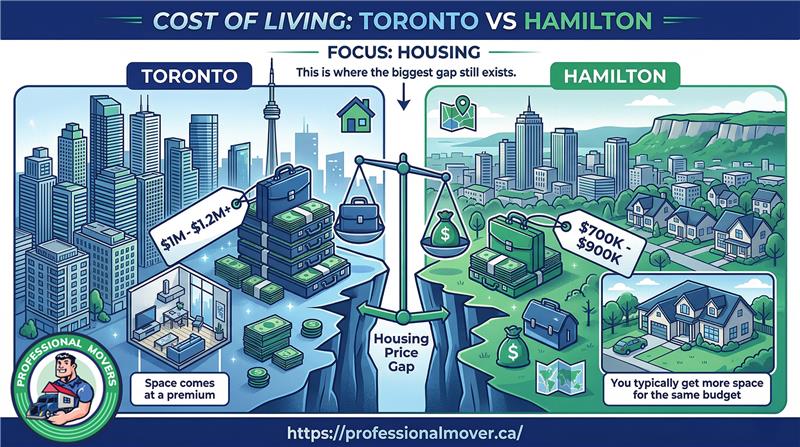
Cost is usually the starting point when moving to Hamilton from Toronto, and yes, Hamilton is still more affordable than Toronto.
But the difference isn’t as simple as “expensive vs cheap.” It’s more nuanced than that.
Housing
This is where the biggest gap still exists.
In Toronto:
- Average home prices often range around $1M–$1.2M+
- Space comes at a premium
In Hamilton:
- Average home prices are closer to $700K–$900K
- You typically get more space for the same budget
Recent market data also reflects how pricing in Hamilton continues to evolve.
According to WOWA’s housing market analysis, average home prices in Hamilton are currently in the mid-$700K range, indicating a more balanced market compared to previous peaks.
Rent
Rental prices also reflect this difference, but less dramatically than many expect.
- Toronto (1-bedroom): $2,300–$2,800/month
- Hamilton (1-bedroom): $1,700–$2,200/month
The gap exists, but it’s narrowing over time.
Daily Expenses
Beyond housing, cost differences are more subtle.
- Groceries and transportation are slightly cheaper in Hamilton
- Utilities are similar or sometimes higher
- Car ownership is more common and can offset savings
Relocating to Hamilton, Ontario, doesn’t mean your life suddenly becomes “cheap.”
It means your expenses are more manageable than in Toronto, and that distinction matters, especially when planning long-term.
From a financial perspective, the move to Hamilton is less about reducing total expenses and more about reallocating budget toward housing, space, and long-term value.
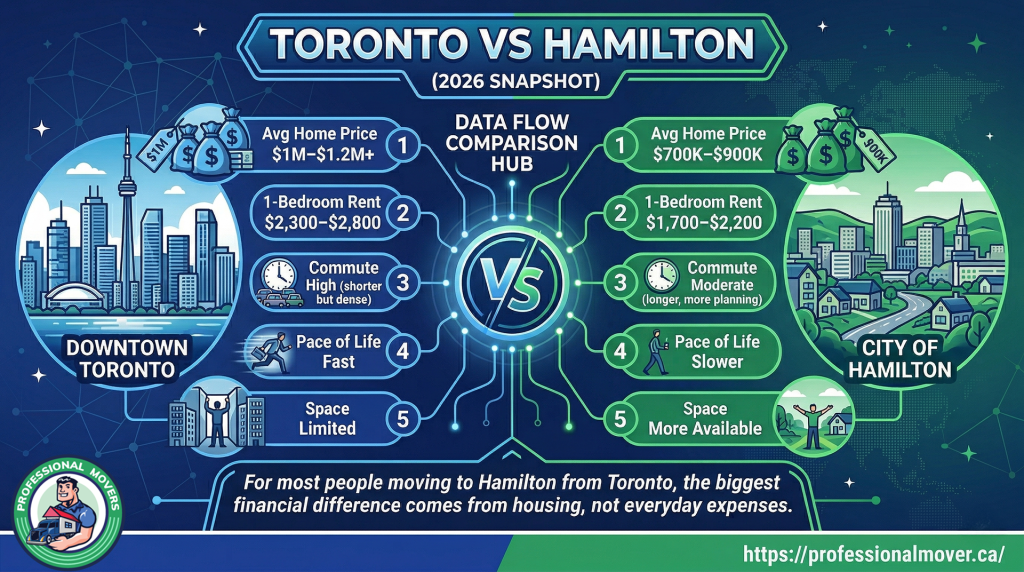
What Actually Changes When You Move to Hamilton
This is where the difference becomes real.
Moving to Hamilton from Toronto doesn’t just change your cost of living.
It changes how your day feels, how you move through the city, and what your routine looks like in Hamilton compared to Toronto.
Most people notice these changes within the first 30–60 days of living in Hamilton.
1. Pace of Life
In Toronto, life tends to feel:
- Fast
- Dense
- Constantly in motion
In Hamilton, the pace shifts:
- More spread out
- Quieter overall
- Less urgency in day-to-day life
For many people, this feels like relief. For others, it can take time to adjust, especially in the first few months after relocating.
2. Commute and Mobility
Your experience here depends heavily on where you work.
If you’re still commuting to Toronto:
- GO Transit often becomes part of your routine
- Commute times increase
- Planning your day becomes more important
If you’re working locally or remotely in Hamilton:
- Daily life becomes significantly easier
- Less time spent in transit
- More predictable routines
3. Daily Convenience
This is one of the more subtle but noticeable differences.
In Toronto:
- Most things are within close reach
- Convenience is built into daily life
In Hamilton:
- Amenities are still available
- But getting to them often requires more planning or travel
What This Means in Practice
Relocating from Toronto to Hamilton isn’t just a financial decision but a lifestyle adjustment.
You’re trading:
- Speed for space
- Convenience for balance
- Density for breathing room
For many, that trade-off improves quality of life. But it’s important to understand it clearly before making the move.
Moving to Hamilton from Toronto: Expectations vs Reality
This is where most decisions around moving to Hamilton from Toronto become much clearer.
A lot of assumptions sound right at first, but don’t fully match real experience after relocating to Hamilton.
Expectation: “Hamilton is much cheaper.”
Reality: It’s more affordable than Toronto, but demand has been rising, and many areas are no longer “budget” options.
Expectation: “It’s basically like Toronto, just smaller.”
Reality: It feels noticeably different, slower, less dense, and less driven by convenience.
Expectation: “The whole city is the same.”
Reality: Your experience depends heavily on where you live in Hamilton.
Two neighbourhoods can feel completely different in terms of lifestyle, accessibility, and day-to-day convenience.
Best Areas to Live in Hamilton After Moving from Toronto
One of the biggest differences after relocating from Toronto to Hamilton is how much your choice of neighbourhood shapes your overall experience.
Unlike Toronto, where much of the city feels consistently urban, Hamilton varies significantly from one area to another.
Lower City (Downtown / Central Hamilton)
- Closer to amenities and services.
- More urban, city-like feel.
- Varies street by street in terms of atmosphere.
Best for:
- People are used to city living.
- Those who want proximity to shops, transit, and activity.
The Mountain (Upper Hamilton)
- More suburban layout.
- Quieter, less dense environment.
- Generally more family-oriented.
Best for:
- Families.
- Long-term living.
- Those prioritizing space and calm surroundings.
Ancaster, Dundas & Flamborough
- More space and a residential feel.
- Quieter, community-focused environments.
- Typically higher price points.
Best for:
- Those prioritizing lifestyle and space.
- Buyers planning long-term.
- People are less dependent on commuting to Toronto.
Key Insight: Where you choose to live in Hamilton will directly shape your day-to-day experience after the move, from commute times to lifestyle and convenience. Unlike Toronto, where the urban experience is more consistent across neighbourhoods, Hamilton varies significantly by area, making location choice one of the most important factors to get right when moving from Toronto.
Who Should Move to Hamilton from Toronto (And Who Shouldn’t)
Not everyone considering a move from Toronto to Hamilton is looking for the same outcome. That’s why this decision works well for some people, but not for others.
Works Well For
Relocating to Hamilton, Ontario tends to be a strong fit if you’re:
- Looking for more space without stretching your budget
- Planning long-term (family life or home ownership)
- Working remotely or with a flexible schedule
- Prioritizing a slower, more balanced lifestyle
Less Ideal For
This move may feel limiting if you:
- Rely on a fast-paced, high-density city environment
- Depend heavily on nightlife, entertainment, or late-night convenience
- Prefer having everything within walking distance
What Surprises People When Moving to Hamilton from Toronto
This is where real experience starts to show, especially in the first few months after moving to Hamilton from Toronto.
1. The Adjustment Period
Even when the move is well planned, there’s always an adjustment phase.
Daily routines change, travel patterns shift, and it takes time to get used to a different pace of life in Hamilton.
2. The City Feels “In Between.”
One of the most common realizations:
Hamilton isn’t fully urban like Toronto, but it’s not entirely suburban either.
It sits somewhere in between, which can either feel like balance or take some getting used to, depending on your expectations.
3. Community Feel
Many people notice a shift in how the city feels socially:
- A more approachable, less rushed environment
- A stronger sense of local community in certain areas
4. Variation Across Neighbourhoods
This often comes as a surprise.
Two areas in Hamilton can feel completely different in terms of:
- Lifestyle
- Accessibility
- Overall atmosphere
This is why choosing the right neighbourhood plays such a critical role in how successful your move feels.
How to Plan Your Move from Toronto to Hamilton
Planning a move between cities isn’t just about packing boxes. It’s about timing, coordination, and getting the details right.
A Toronto-to-Hamilton move may seem straightforward on paper, but small missteps in scheduling or logistics can quickly lead to delays, added costs, or unnecessary stress.
1. Start Early
For a smooth move from Toronto to Hamilton, timing plays a bigger role than most people expect.
- Book movers at least 2–4 weeks in advance (earlier during peak seasons)
- Align closing or lease dates to avoid overlap issues
- Plan logistics like parking, elevator access, and timing
Families also need to coordinate the moving date with school registration, childcare, possession timing and the first week in the new home. Our guide to moving to Hamilton with kids explains how to organize these details before moving day.
2. Declutter Before Moving
The more you move, the more you pay.
- Reduce volume to lower moving costs
- Avoid packing and transporting unnecessary items
- Simplify unpacking at your new home in Hamilton
Even a small reduction in volume can noticeably impact overall cost.
3. Choose the Right Moving Support
This is where most of the complexity comes in. Choosing experienced Toronto to Hamilton movers helps manage:
- Long-distance logistics and route planning
- Timing between pickup and delivery
- Coordination across buildings, access points, and schedules
For a move like this, having the right team ensures everything stays on track from start to finish.
4. Understand Moving Costs
The cost of moving to Hamilton can vary depending on several factors:
- Distance between locations
- Volume of items being moved
- Services required (packing, storage, specialty items)
- Timing (weekends and peak periods can cost more)
Getting a detailed estimate in advance helps avoid unexpected costs.
Key Planning Insight: Most issues during a Toronto-to-Hamilton relocation aren’t caused by the move itself, but by poor timing, underestimated logistics, and last-minute decisions. Delays and cost overruns typically stem from avoidable factors such as scheduling conflicts, parking or elevator access, and misaligned timelines between Toronto and Hamilton. In most cases, these issues are not driven by distance but by gaps in coordination and planning.
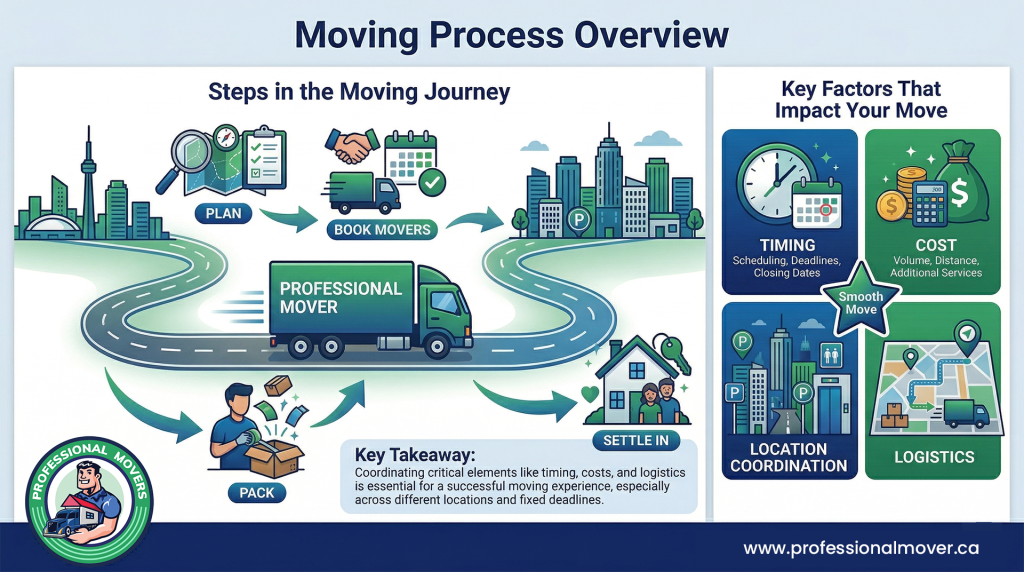
In practice, many of these variables are handled more effectively by experienced Toronto-to-Hamilton movers like Professional Movers, reducing uncertainty throughout the process.
To see how the move can be made easier and what options are available based on your specific needs, you can explore our Hamilton Movers’ Services.
The Key Decision You’ll Face When Moving to Hamilton from Toronto
The decision ultimately depends on how the trade-offs align with your lifestyle priorities and long-term plans.
- If your priority is space, affordability, and balance, Hamilton is likely the better fit.
- If your routine depends on density, speed, and immediate access, Toronto may still align more closely with it.
In most cases, the success of the move depends on how clearly these priorities are defined before relocating.
Final Verdict: Is Relocating from Toronto to Hamilton, Ontario, the Right Move?
Relocating to Hamilton, Ontario, isn’t about finding a perfect replacement for Toronto.
It’s about choosing a different way of living, one that prioritizes:
- more space
- better balance
- a slower, more manageable pace
For many people, that shift is exactly what they’ve been looking for, especially after years of living in Toronto.
For others, it can take time to adjust, particularly if their lifestyle depends on speed, density, and constant access to everything.
Ultimately, the success of relocating to Hamilton depends less on the move itself and more on how well expectations align with the realities of daily life in a less dense, more space-oriented city.
Frequently Asked Questions About Moving to Hamilton from Toronto
1. Is Hamilton cheaper than Toronto?
Yes, Hamilton is generally more affordable than Toronto, particularly when it comes to housing. Home prices and rent are typically lower, allowing for more space at a similar or reduced budget. However, affordability varies by neighbourhood, and rising demand has narrowed the gap in recent years. Overall, Hamilton is not “cheap,” but it is more manageable compared to Toronto, especially for long-term living.
2. Can you commute from Hamilton to Toronto for work?
Yes, commuting from Hamilton to Toronto is possible and fairly common, especially for those working in hybrid roles. Most commuters rely on GO Transit, with travel times typically ranging from 1 to 1.5+ hours each way, depending on the route and schedule. This arrangement is manageable but requires planning and is best suited for flexible work schedules.
3. Is Hamilton a good place to live long-term?
Yes, Hamilton is considered a strong long-term option for many people, particularly families, first-time homebuyers, and remote workers. The city offers more space, relatively lower housing costs compared to Toronto, and a slower, more balanced lifestyle. Long-term suitability depends on whether you prioritize space and affordability over convenience and density.
4. Is moving to Hamilton from Toronto worth it in 2026?
For many people, moving to Hamilton from Toronto is worth it in 2026, especially if priorities are shifting toward space, affordability, and a more manageable pace of life. Hamilton offers a different lifestyle from Toronto, with lower density and more room to grow. The move tends to make sense when these lifestyle trade-offs align with your long-term goals.
5. What is the cost of moving to Hamilton from Toronto?
The cost of moving from Toronto to Hamilton typically ranges from $800 to $2,500+, depending on the size and complexity of the move. Pricing is influenced by factors such as distance, item volume, required services like packing or storage, and timing, including weekends and peak seasons. The most accurate estimate comes from requesting a detailed quote based on your specific needs.

More Moving Articles
Cost to Move a 3-Bedroom House in Calgary
Testimonials

Love and Harsharan were Amazing. They showed up when they said, got right to work and didn't go over the time allotted. They were gentle with everything and very well mannered. 100% recommend. Thank you guys for making this move easy for us
- Marsha Widmeyer
Contact Us
"*" indicates required fields
Complete Moving and Storage Solutions Across Canada

Contact Our team
Call Professional Movers Canada or fill out our free moving quote form.

Get Your Quote & Plan
Receive an obligation-free estimate and a detailed plan of action for your move.

Experience a Smooth, Professional Move
Leave all the vexing tasks of relocation to our skilled Canada movers.