
Get Your Free Estimate Now
"*" indicates required fields






A family move can change more than the address on a school record. A new home may also mean a different school, teacher, peer group, daily routine, academic program, or level of learning support.
For parents moving with children in Canada, the bigger challenge is maintaining academic continuity while a child moves from one school environment to another.
The transition can require more attention when the move happens during the school year, crosses a provincial boundary, or involves a child with established learning supports or secondary-school requirements.
These pressures can also appear during a shorter relocation. Our guide to moving to Hamilton with kids shows how school dates, childcare, possession time and property access can all affect the same moving week.
The goal is to identify the decisions that need attention early so the child can enter the new school with fewer gaps in learning, support, or routine.
Practical Moving Review
Reviewed by: Mr. Kamalpreet Singh, Operations Manager (Canada),
Professional Movers Canada
Last reviewed: August 2026
Review scope: Family-move scheduling around school start dates, moving-day priorities, interprovincial relocation coordination, essential-item planning, and unloading sequence.
Mid-Year and Summer Moves Create Different Academic Pressures

When timing a family move during the school year in Canada, the academic handoff matters as much as the moving date.
A summer transfer and a mid-year transfer create different questions for the receiving school and the child.
Summer Move
A summer move gives families more time between schools, but important decisions may still need to happen before September.
Check:
- registration and program deadlines
- orientation or school-start information
- course selection for secondary students
- learning-support arrangements
- records the receiving school needs before classes begin
Mid-Year Move
A mid-year transfer happens while coursework, assessments, and classroom routines are already underway.
Ask both schools how they will handle:
- assignments already in progress
- upcoming tests or major assessments
- report cards and recent academic records
- course sequence and prerequisites
- learning supports or accommodations
- credits for secondary-school students
Younger children may feel the disruption more through changes in teacher, classmates, and routine.
Older students may face additional concerns around course placement, credits, or graduation planning.
Academic Planning Point: The better timing is not automatically summer or mid-year. Compare the child’s academic stage, current coursework, registration timing, and support needs before deciding what transition will require the least disruption.
Verify the School Assignment Before You Rely on the Address
The nearest school is not always the school your child will attend.
Families finding a new school after relocation should verify the prospective address with the local board or district rather than assume which school serves the neighbourhood.
Education is administered provincially and territorially in Canada, while local school boards, districts, divisions, or other authorities may set attendance-area and enrolment rules. [Source: Council of Ministers of Education, Canada]
- Before treating the school plan as settled, confirm:
- whether the address falls within the school’s attendance area
- whether space is available in the required grade
- whether a preferred program has separate eligibility or application rules
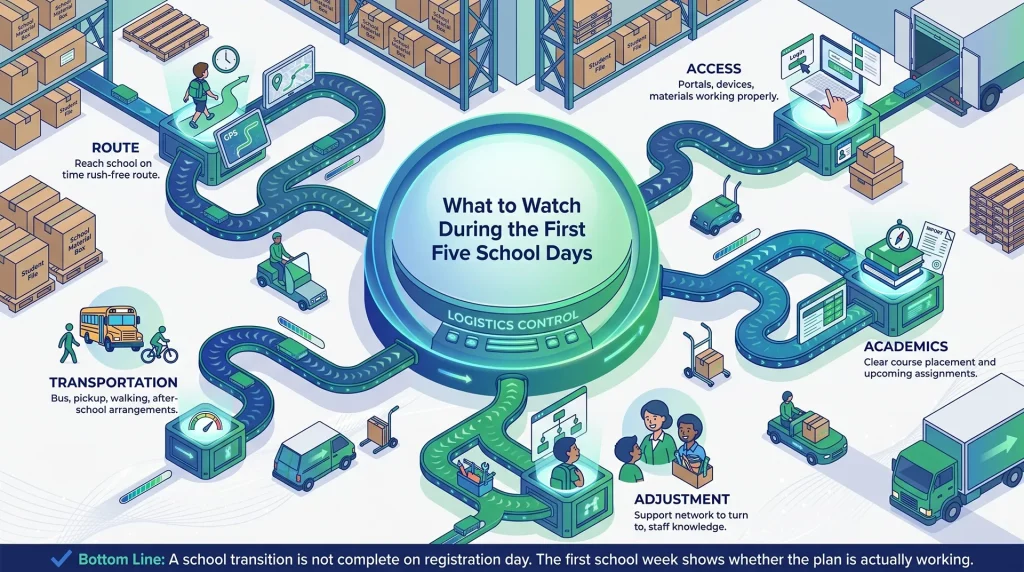
- whether transportation or busing applies to the address
- whether the daily route works with before- or after-school care
A school may fit academically but still create a difficult daily routine if transportation, program access, or placement does not work for the family.
School Placement Check: Verify address → school eligibility → program availability → transportation before treating the school plan as confirmed.
Even a shorter move can change school boundaries, childcare arrangements and the weekday commute. Our Downtown Toronto-to-Oakville family moving guide shows why families should check those daily routines against the exact new address.
Treat Registration and Academic Records as One School Handoff
School registration and academic continuity are connected, but they solve different problems.
For families handling school registration after a move, checking the receiving school’s requirements early can prevent missing paperwork from becoming a last-minute problem.
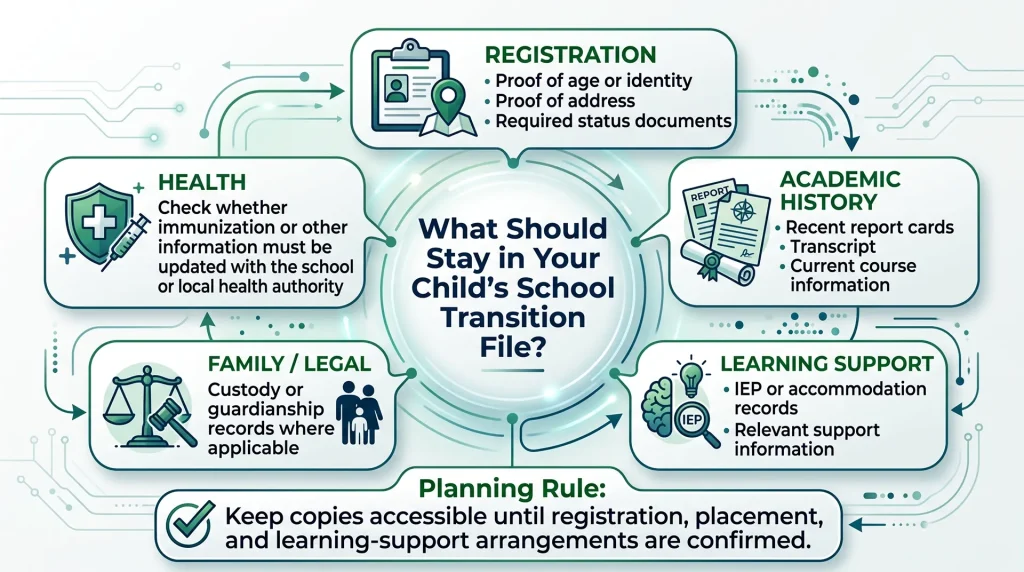
Registration documents establish whether the child can be enrolled. Requirements vary by province, board, district, and the student’s circumstances. Depending on the school system and family situation, documents may include:
- proof of age or identity
- proof of the new home address
- immigration or status documents, where applicable
- custody or guardianship records, where applicable
Check the receiving authority’s current requirements rather than assuming one Canadian standard. TDSB and Vancouver School Board publish their own registration guidance.
TDSB currently lists proof of age and address among its required documentation, while VSB’s current guidance also covers status documents and parental-responsibility records in applicable situations.
Academic records serve a different purpose. They help the receiving school understand where the child is academically and what support may already be in place. Keep accessible copies of:
- recent report cards
- current coursework or major assignments
- IEPs or learning-support documentation, where applicable
- information about accommodations already being used
For example, the Vancouver School Board specifically asks families in relevant registration situations to provide report cards and available IEP or other learning-support records.
Ask the current school what it will transfer directly and what the family should provide.
Give Your Child a Transition They Can Picture
Children often worry about details adults treat as secondary.
Many of the best practices for moving kids to a new school focus on making unfamiliar parts of the first day more predictable.
A younger child may care most about:
- who will meet them at the classroom door
- where they will sit
- how they will get to school
A teenager may be more concerned about:
- friends and activities
- course choices
- the new commute
- whether the move changes their independence
Replace vague reassurance with information your child can use. Show the route to school, point out the bus stop or drop-off area, talk through the first-day schedule, and explain which familiar routines will stay the same.
Give them some age-appropriate control. Visiting the neighbourhood, choosing what stays accessible during the move, or planning how to stay in touch with old friends can make the transition feel less abstract.
A clear picture of the first week is usually more useful than promising the adjustment will be easy.
Plan Moving Day Around the First School Morning
A family can be fully moved into the new home and still be poorly prepared for the next school morning.
Keep medication, identification, school documents, devices, and other critical items with the family, not in the moving truck.
If classes begin within a day or two of the move, prioritize the first-night setup around bedtime, breakfast, getting dressed, and leaving for school on time.
Share the fixed school start date with the moving team during quotation and scheduling. A family that needs to be school-ready the next morning may need a different unloading sequence from one with several days to settle in.
Mover’s Note: Ask the moving team to prioritize household items needed for the first night and school morning, such as bedding, clothing, lunch supplies, and school bags. Loading and unloading orders can be planned so those items are easier to reach after arrival.
Crossing a Provincial Border? Check the Academic Handoff Early
An interprovincial move can create a different school transition from a move within the same board or district.
Canada has 13 provincial and territorial education systems, not one integrated national system.
Curriculum, assessment, course structures, and graduation requirements can therefore differ when a student moves between jurisdictions. Source: Council of Ministers of Education, Canada
Pay Closer Attention for Secondary Students
Before the move, ask the receiving school to review:
- the current transcript
- courses already in progress
- prerequisites
- credits earned
- graduation requirements that still need to be met
Similar course names do not always mean an identical transfer.
Use the Receiving School to Check Placement
CMEC maintains a Student Transfer Guide to help schools assess placement when secondary students move between provinces or territories.
For students approaching graduation, resolve credit or course-sequence questions before the move where possible.
Key Takeaway: For moves between provinces such as Ontario, British Columbia, Alberta, or Quebec, confirm how current courses, credits, and prerequisites fit the receiving province’s program.
Families moving from Ontario to British Columbia should also compare the school start date with their shipment’s delivery window. Our Toronto-to-Vancouver moving cost guide explains how accommodation, storage and delivery timing can affect the wider family budget.
Build the Move Around the School Timeline
A school start date, registration deadline, or fixed academic commitment can leave very little room for delays in the household move.
When those dates are already set, plan the physical relocation around them, including property access, loading and unloading priorities, travel time, and the items your family needs immediately after arrival.
Professional Movers Canada can coordinate crew timing, property access, loading, and unloading around fixed school dates and household priorities.
Get Your Free Moving Estimate →

More Moving Articles
Testimonials

Love and Harsharan were Amazing. They showed up when they said, got right to work and didn't go over the time allotted. They were gentle with everything and very well mannered. 100% recommend. Thank you guys for making this move easy for us
- Marsha Widmeyer
Contact Us
"*" indicates required fields
Complete Moving and Storage Solutions Across Canada

Contact Our team
Call Professional Movers Canada or fill out our free moving quote form.

Get Your Quote & Plan
Receive an obligation-free estimate and a detailed plan of action for your move.

Experience a Smooth, Professional Move
Leave all the vexing tasks of relocation to our skilled Canada movers.