
Get Your Free Estimate Now
"*" indicates required fields






Moving homes in Brampton might seem straightforward at first. This is especially true if you are staying within the GTA.
However, every local area presents its own moving challenges. Castlemore features larger detached homes and low-density suburban layouts. Meanwhile, high-volume residential zones like Credit Valley require entirely different logistics.
This is even more evident in Mount Pleasant. Here, compact townhouse layouts feature tighter entryways and limited interior space. As a result, these constraints can quickly slow down movement.
For most families, moving requires careful planning, coordination, and serious physical effort. The real challenges often involve driveway access limitations and condo elevator bookings. Furthermore, peak-hour congestion along Highway 410 and Queen Street causes major delays.
This moving guide for Brampton, Ontario, breaks down the exact realities of residential transit. We explain freight logistics, packing strategies, and on-the-ground execution.
Whether relocating within Brampton or moving across the GTA, preparation is vital. The entire process depends on how well you plan your household inventory.
Ultimately, moving a family home isn’t just about getting from point A to point B. It is about managing everything inside that home efficiently, safely, and without delays.
What Most Brampton Families Underestimate About Moving Volume and Effort

A move within Brampton is often treated as quick and manageable, especially when the distance is short. That assumption is where most problems begin.
In areas like Castlemore or Credit Valley, this often means larger homes with multiple storage-heavy levels that significantly increase transit time.
What looks like a simple move usually involves far more than expected.
A typical family home includes multiple furnished rooms, as well as less visible spaces such as basements, garages, and attics, all filled with storage.
Then there are the heavier items that define the move:
- Sectionals, bed frames, and solid wood furniture
- Appliances like refrigerators and laundry units
- Basement gym equipment or packed storage racks
- Outdoor items like patio furniture, BBQs, and lawn equipment
These items require proper wrapping, lifting coordination, and structured transit staging to ensure efficient loading and prevent damage during residential transit.
While self-packing is common, it introduces liability risks, especially for Packed By Owner (PBO) cartons under standard transit conditions.
For fragile or high-value items, professional packing is recommended to ensure proper protection and liability coverage.
Pre-move packing and staging alone take longer than expected.
Once you factor in staging items by room and positioning the truck for access, timelines stretch quickly.
Highway 410 and surrounding routes often experience peak-hour congestion in the evenings.
Delays in transit schedules are common during Brampton-to-GTA commutes.
What starts as a half-day move often turns into a full day.
Many families only realize midway that the scale, both physical and logistical, was underestimated.
Expert Insight: Most delays in Brampton residential relocations are caused by underestimating loading complexity and access constraints, not travel distance.
What You’re Actually Moving in a Brampton Home: Furniture and Household Inventory

Every home has its own layout, but most Brampton families follow a similar structure.
It’s not just about boxes; it’s about relocating an entire household system, where each area brings its own requirements.
In your main living areas and bedrooms, you’re dealing with larger furniture that needs to be disassembled, protected, and moved in sequence:
- Sofas and sectionals that require wrapping before loading
- Bed frames, mattresses, dressers, and wardrobes
- TVs and electronics that need padded packing and secure placement
How Different Areas of Your Home Impact Moving Time
In most Brampton family homes, each area adds its own level of complexity to the move, requiring a specific handling approach.
This is especially true across Brampton neighbourhoods such as Castlemore, Credit Valley, and Mount Pleasant.
For example, moving a 4-bedroom estate in Castlemore requires a completely different loading and staging strategy than moving into a tight rear-lane townhouse in Mount Pleasant.
The requirements, access points, and handling approach change significantly between the two.
These areas typically include multi-level storage spaces that increase the effort required for packing and loading.
The kitchen adds a different layer of complexity. Appliances require careful handling.
Fragile items like glassware and dishes must be packed to prevent shifting during transit.
Beyond the main rooms, certain areas significantly expand the scope of the move:
- Basement spaces with stacked storage bins, seasonal items, and utility setups that need sorting before packing.
- Garage storage systems, including shelving units, tool chests, and loose equipment, all require bundling and safe loading.
- Outdoor areas, where patio sets, planters, and weather-exposed items need cleaning, wrapping, and staging before they can be moved.
Each zone requires a different handling protocol within the moving workflow.
Items are grouped by zone to enable an efficient loading sequence and access optimization.
As the volume increases across these spaces, so does the time, labour, and coordination required. This directly impacts loading duration and overall relocation timeline.
Key Insight:In most cases, 60–70% of total moving time is spent on loading alone, especially in homes with basements and garage storage. This is why preparation and an efficient loading strategy matter more than distance in most local moves in Brampton.
Step-by-Step Residential Relocation Workflow in Brampton
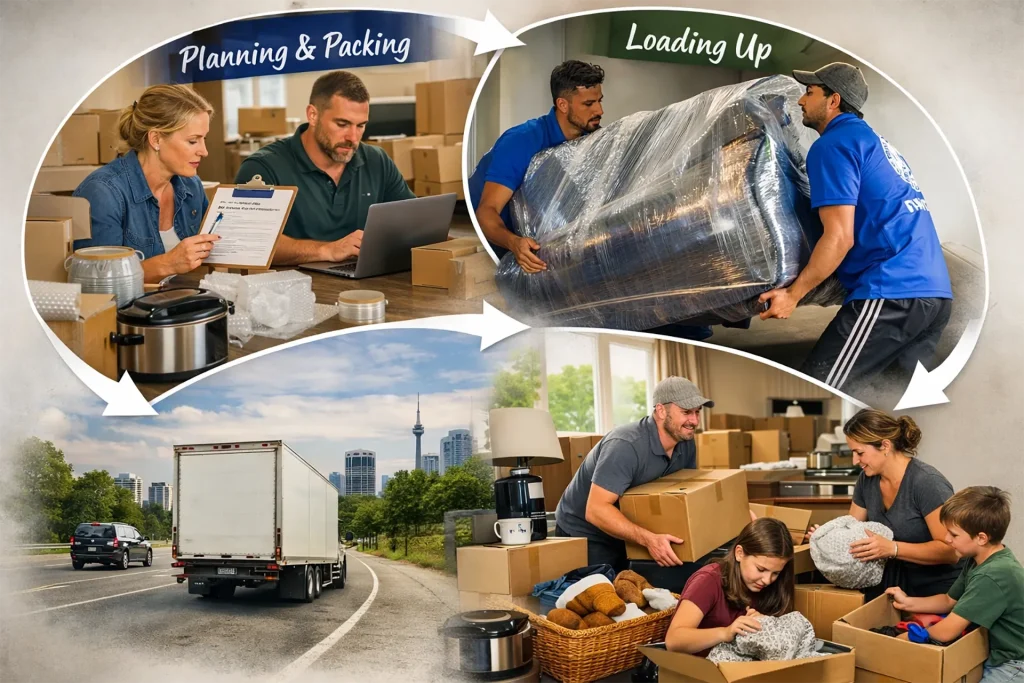
Once the move begins, everything follows a sequence.
When it’s planned properly, the process feels controlled and efficient. When it isn’t, delays start to build at every stage.
Preparation Comes First
- Before anything is moved, the focus is on getting everything ready:
- Furniture is wrapped using protective materials
- Fragile items are secured and boxed properly
- Items are grouped by room for easier unloading
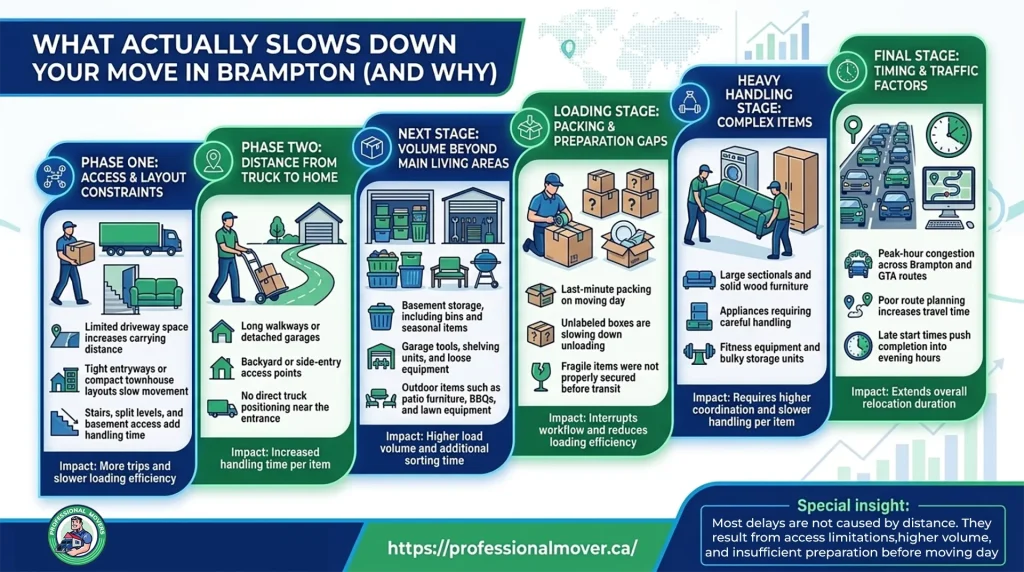
- Access is assessed, including driveway space, entry points, and distance to the truck
Loading Sets the Pace for the Entire Move
Loading efficiency determines the pace of the entire residential transit workflow, as it directly impacts both labour time and transport scheduling.
- Heavy items like sofas, appliances, and bed frames are loaded first
- These form a stable base inside the truck
- Boxes and lighter items are then stacked around them to prevent shifting
In many Brampton homes, things like:
- Stairs and basement access
- Garage or backyard carry distances
It can slow this stage down if not managed properly.
Transport Still Depends on Timing
Transit scheduling within the GTA is influenced by traffic density, route optimization, and peak-hour congestion patterns.
- Traffic patterns affect travel time
- The time of day can impact how quickly the truck moves
- Route planning helps avoid unnecessary delays
Unloading and Setup at the New Home
Once the truck arrives, the goal is to get your home functional as quickly as possible:
- Items are placed room by room
- Priority is given to bedrooms and the kitchen
- Basic furniture is set up so your first night is manageable
What This Looks Like for a Typical Family Relocation
For most 3-bedroom homes in Brampton:
- 3 to 4 movers handle the move
- 4 to 6 hours are needed just for loading
- The entire process is usually completed within the day, depending on access and volume
Expert Insight: A structured loading sequence and proper transit staging improve relocation efficiency more than increasing crew size.
Optimal Timing Strategy for Brampton Residential Moves
The difference between a smooth move and a chaotic one often comes down to timing.
A few weeks before your move, early decisions start shaping how efficiently everything comes together:
- Booking movers in advance ensures you get your preferred date and crew
- Decluttering reduces unnecessary volume and loading time
- Planning access, like driveway space and parking, prevents delays on moving day
You can review parking and access guidelines through the City of Brampton before moving day.
As the move gets closer, packing should already be underway, not left for the last minute.
A full household takes time to organize, especially when items from different areas need to be grouped and prepared for loading.
On moving day, preparation makes the biggest difference.
When everything is packed, labelled, and ready before the truck arrives, the crew can move continuously without interruptions.
Key Insight: The better prepared you are before moving day, the faster and more efficiently your entire move comes together.
The Logistics of Moving Within Brampton and the GTA
Even local moves come with logistical challenges that can directly affect both time and cost.
When planning a family move in Brampton, these details often make the difference.
In Brampton’s suburban neighbourhoods, access and layout play a bigger role than most families expect:
- Driveway access directly affects property access constraints, influencing loading efficiency and overall residential transit speed.
- In compact layouts, restricted entry points create significant freight logistics limitations, slowing down item handling and movement flow.
- Stairs, split levels, and basement access add time, especially when moving heavier items
These factors don’t just affect effort, they influence how efficiently the crew can maintain a steady loading flow.
Across the GTA, timing becomes just as important as access. Even when the distance is short, traffic patterns can impact the overall schedule:
- Peak hours can delay transport significantly
- Route selection affects how quickly the truck reaches your new home
- Poor timing can extend what should be a short move into a longer one
In most moves within the GTA from Brampton, delays aren’t caused by distance, they’re caused by access constraints and timing decisions.
These may seem like small details individually, but together, they determine how smoothly your move runs.
What Really Drives Moving Costs in Brampton (Labour, Access & Volume)

One of the most common questions families in Brampton have is about moving costs, and it’s not just based on distance.
Moving costs are primarily driven by labour hours, freight logistics complexity, property access constraints, and total household volume.
Liability coverage requirements also influence cost structure when professional packing and high-value item handling are involved.
These factors typically include:
- The size of your home and the overall volume of items
- The number of movers required to complete the job efficiently
- Access conditions, such as stairs, entry points, or distance from the truck
- The level of packing and preparation needed before loading
For most local moves in Brampton, a 3-bedroom home typically falls within the $800 to $1,500 range, depending on the home’s size, access, and overall complexity.
Adding spaces like basements, storage zones, and outdoor areas increases both volume and handling time, which directly impacts labour.
Since most moves are time-based, anything that slows loading or unloading, such as longer carry distances or heavier items, affects the final cost.
That’s why accurate estimates are based on what needs to be moved and how complex the process is, not just where you’re going.
Pricing Methodology: These estimates are based on aggregated 2026 regional dispatch patterns, labour rate averages, and standard residential relocation benchmarks across Brampton and the GTA.
Estimated Moving Costs in Brampton (2026)
We aggregated 2026 dispatch data and rate sheets from local moving companies to estimate the baseline costs below.
| Home Size | Crew Size | Estimated Time | Typical Cost Range |
|---|---|---|---|
| 1-Bedroom Apartment | 2 Movers | 2–4 hours | $300 – $700 |
| 2-Bedroom Home | 2–3 Movers | 3–5 hours | $500 – $1,000 |
| 3-Bedroom Home | 3–4 Movers | 4–8 hours | $800 – $1,500 |
| 4+ Bedroom Home | 4–5 Movers | 6–10+ hours | $1,200 – $2,500+ |
Brampton Relocation Checklist for Families (Step-by-Step)
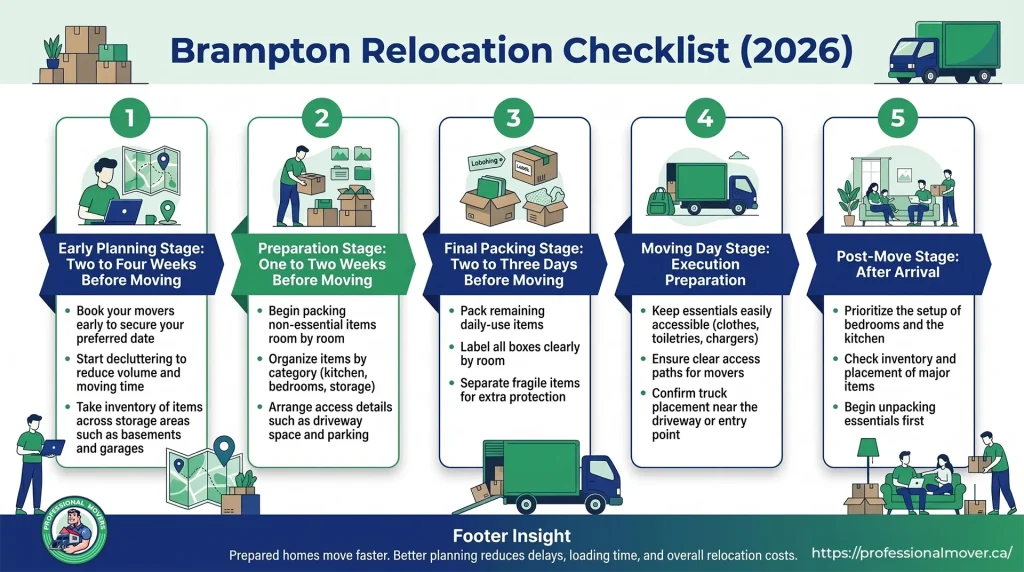
A well-organized move starts with a clear plan. Here’s a simple checklist to stay on track:
- Book your movers at least 2–4 weeks in advance
- Start decluttering early to reduce the load
- Pack non-essential items ahead of time
- Label boxes clearly by room
- Set aside essentials for your first night
- Confirm parking and access at both locations
Small steps like these make a big difference when a moving day arrives.
Plan Your Brampton Move with Clarity
Every move comes down to execution, how well it’s planned, packed, and handled from start to finish.
If you’re moving within Brampton, the key is to understand your timeline, your home’s size, and any access or layout constraints before moving day.
That clarity is what keeps your move on schedule and avoids last-minute delays.
This complete moving guide for Brampton, Ontario families is designed to help you plan smarter, move efficiently, and avoid common setbacks.
Get a Free Moving Estimate → Brampton Movers
Our moving practices align with the Canadian Association of Movers (CAM) industry standards for safety, handling procedures, and customer protection expectations.
See exactly how long your move will take, what it will cost, and how it will be executed before moving day.
Brampton Moving FAQs: What Families Need to Know
How long does it take to move to a 3-bedroom home in Brampton?
A typical 3-bedroom home takes 4–6 hours to load with a 3–4-person crew. The full move is usually completed within the same day, depending on access and volume.
What can increase the time required on moving day?
Factors like stairs, basement access, long carry distances, and heavy items can extend loading time. Poor preparation or last-minute packing can also slow the process.
How much does it cost to move within Brampton?
Moving a standard family home within Brampton typically costs between $800 and $1,500, depending on labour hours, access conditions, and household volume. Costs depend mainly on labour time, crew size, and property access constraints.
How early should I book movers in Brampton?
Booking 2–4 weeks in advance is recommended to secure your preferred date, especially during peak moving periods.
Do I need to have everything packed before the movers arrive?
Yes, unless you’ve requested packing services. Moves run significantly faster when everything is packed, labelled, and ready before loading begins.
Can movers handle heavy or specialty items?
Professional movers handle appliances, large furniture, and bulky items, using proper wrapping, equipment, and loading techniques.

More Moving Articles
Testimonials

Love and Harsharan were Amazing. They showed up when they said, got right to work and didn't go over the time allotted. They were gentle with everything and very well mannered. 100% recommend. Thank you guys for making this move easy for us
- Marsha Widmeyer
Contact Us
"*" indicates required fields
Complete Moving and Storage Solutions Across Canada

Contact Our team
Call Professional Movers Canada or fill out our free moving quote form.

Get Your Quote & Plan
Receive an obligation-free estimate and a detailed plan of action for your move.

Experience a Smooth, Professional Move
Leave all the vexing tasks of relocation to our skilled Canada movers.