
Get Your Free Estimate Now
"*" indicates required fields
Vancouver is world-renowned for its stunning mountain views and vibrant urban lifestyle. However, as 2026 brings record-high housing costs, many residents are redefining what “quality of life” actually means. Moving from Vancouver to Surrey has become a strategic choice for families and professionals seeking more square footage without sacrificing the convenience of Metro Vancouver.
With Surrey’s population growth now outpacing Vancouver’s, a clear trend has emerged: residents are trading cramped downtown condos for spacious, modern homes in thriving suburban communities.
When comparing the two cities, the gap in affordability and long-term investment value is impossible to ignore. From selecting reliable movers to exploring the best neighborhoods, this guide offers essential insights to help you make your 2026 transition easier and more successful.
Why Vancouver Residents Are Rethinking Their Living Situation
Nobody leaves Vancouver for Surrey on a whim. Intense market pressures in 2026 sparked this strategic move. Let’s explore why the ‘Surrey Migration’ is currently trending:
Rising Condo Prices and Limited Living Space in Vancouver
Living in Vancouver often feels like paying a premium price for a “shoebox.”
- Small Units, High Price: In prime areas like Downtown or Kitsilano, paying $1,000–$1,500 per square foot has become the norm. When you spend that much and still struggle to fit a full-sized sofa in your living room, you start to question the value.
- Storage and Privacy Issues: Vancouver condos are notorious for their lack of storage. If you have camping gear, bikes, or even just growing piles of kids’ toys, the walls start closing in fast. Plus, with towers built so close together, your balcony often feels like a shared stage with your neighbor. Privacy has become a true luxury.
The True Cost of Vancouver Living Beyond Rent or Mortgage
Many buyers focus solely on the monthly mortgage. However, the “hidden costs” of Vancouver living are what truly break the bank.
-
Strata Fees: Old buildings often require constant repairs, while new ones charge for luxury amenities. Consequently, strata fees in Vancouver climb higher every single month.
-
Property Taxes: Property assessments in Vancouver remain sky-high. Therefore, the tax burden on homeowners rises consistently year after year.
-
Daily Expenses: Furthermore, the issue goes beyond housing; it includes the general cost of living. You might pay $15 an hour for parking or premium prices for groceries. Ultimately, these small costs add up to thousands in lost savings annually.
Life Stage Changes Driving the Move
As we move through 2026, lifestyle priorities have shifted significantly:
- Growing Families: If there’s a new baby on the way or your kids are getting older, you need a backyard and separate bedrooms. A tight 1-bedroom or “den-heavy” 2-bedroom in Vancouver just doesn’t cut it for a family that needs room to breathe.
- Work-from-Home Needs: Remote and hybrid work are now permanent fixtures of the economy. Professionals are tired of working from their kitchen tables. They want a dedicated home office, something that is an affordable reality in a Surrey townhouse but a dream in a Vancouver condo.
- Long-term Stability: Many are tired of the “renter’s anxiety,” the fear of a landlord selling the unit or rent hikes every year. Moving to Surrey allows people to transition from “temporary living” to “long-term ownership,” providing a sense of security and stability.
Moving from Vancouver to Surrey – What You Lose vs What You Gain
Making the move from the “Core” to the “Burbs” is a psychological shift as much as a physical one. To make a confident decision, you need to be honest about what you are leaving behind and what is waiting for you on the other side.
What You May Be Giving Up in Vancouver
Let’s be real, Vancouver is iconic for a reason, and moving to Surrey does mean saying goodbye to a few specific perks:
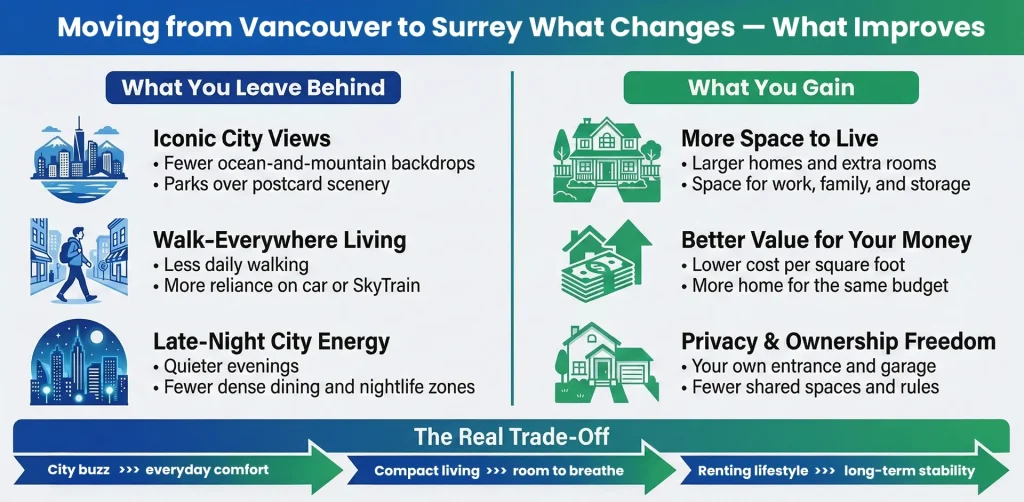
- The Iconic Views: You likely won’t have the North Shore mountains or the English Bay sunset right outside your window. Surrey has beautiful parks, but it lacks that immediate “ocean-meets-mountain” drama that defines Vancouver.
- Walkable Downtown Lifestyle: In Vancouver, you can often survive without a car. Everything from your favorite coffee shop to your doctor is a 10-minute walk away. In Surrey, while some areas are walkable, you will likely become more dependent on your vehicle or the SkyTrain.
- The Nightlife & Dense City Vibe: If you love the energy of a crowded Granville Street on a Saturday night or having 50 different high-end restaurants within a five-block radius, Surrey will feel a bit quieter. It’s a “residential-first” city, which means things close a bit earlier and the streets aren’t as buzzy after dark.
What You Gain by Moving to Surrey
- Massive Increase in Square Footage: This is the biggest win. For the price of a cramped 600 sq. ft. condo in Vancouver, you can often find a 1,500+ sq. ft. townhouse in Surrey. That means an extra bedroom, a dedicated office, and a kitchen where two people can actually cook at the same time.
- Lower Cost Per Square Foot: Your dollar goes further in Surrey. In 2026, you aren’t just buying “space”; you’re buying “value.” You’re getting more “house” for every dollar spent, which leads to better long-term equity.
- Ownership Stability & Privacy: Say goodbye to shared hallways, noisy upstairs neighbors, and restrictive condo bylaws. In a Surrey townhouse or detached home, you get your own front door, your own garage, and a backyard where you can host a BBQ without asking for permission from a strata board. It’s the feeling of truly “owning” your life.
Living in Surrey vs Vancouver Space and Lifestyle Comparison
In 2026, the “lifestyle gap” between these two cities has widened. While Vancouver offers the prestige of the “V” postal code, Surrey offers a reality where you can actually stretch your legs.
Vancouver Condos vs Surrey Townhouses and Detached Homes
The biggest shock for movers is the physical change in their daily environment. In Vancouver, your “outdoor space” is usually a 50-square-foot concrete balcony. In Surrey, it’s often a fenced backyard or a spacious patio.
- Private Outdoor Space: In Surrey, kids and pets actually have room to run.
- Parking: Say goodbye to fighting for a narrow underground stall. Most Surrey homes offer private garages or multiple driveway spots.
Same Budget, Different Reality (The 2026 Comparison)
To give you a clear picture, let’s look at what a typical budget of $800,000 to $900,000 gets you in both cities right now.
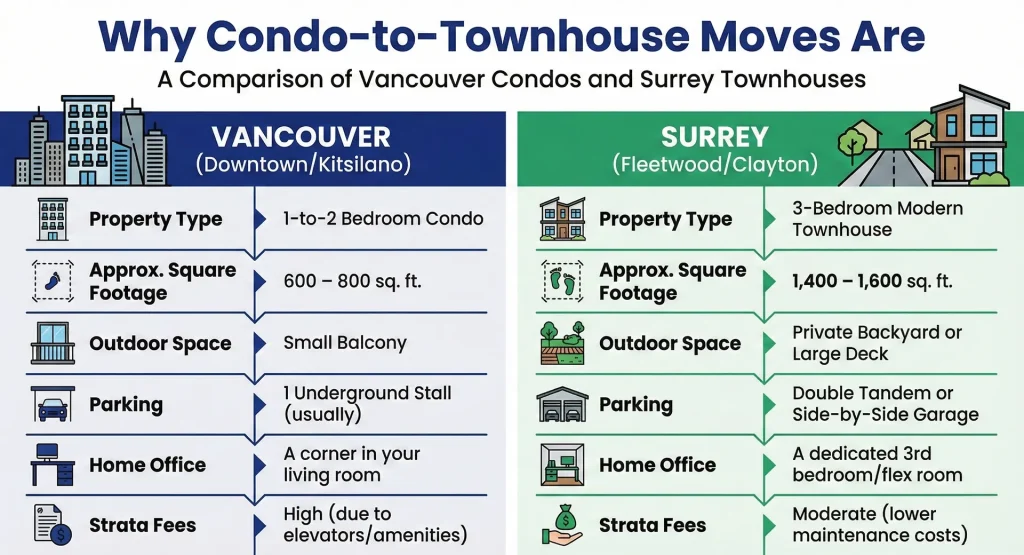
We are seeing a massive trend of “condo-exhaustion.” After the pandemic years, the “Work-from-Home” culture became the standard. People realized that living in a beautiful city like Vancouver isn’t fun if you are trapped in a small room all day.
Buyers are now prioritizing long-term value over commute proximity. They are choosing to move to Surrey because a townhouse isn’t just a home; it’s an appreciating asset that accommodates a growing family, whereas a 1-bedroom condo has a very short “shelf life” for a couple.
Cost of Living Surrey vs Vancouver
When people ask, “Is it cheaper to live in Surrey than Vancouver?” The answer is a resounding yes but it’s not just about the mortgage. It’s the cumulative effect of several smaller expenses that add up to a much larger “savings pool” at the end of every month.
Housing Prices and Rent Comparison
Housing is, without a doubt, your biggest expense. In early 2026, although Metro Vancouver rents have trended slightly downward, Vancouver proper remains the “premium” zone.
- Rent: A typical 1-bedroom in Vancouver averages around $2,600–$2,800, while in Surrey, you can find similar units (often newer) for $1,700–$1,900. That’s nearly $1,000 a month back in your pocket.
- Buying: The benchmark for a detached home in Vancouver is still comfortably over $2M, whereas in Surrey, you can find spacious detached homes for $1.3M–$2M.
Property Taxes, Utilities, and Monthly Expenses
A common myth is that because Surrey homes are bigger, they are much more expensive to maintain. While a larger home does use more heat, Surrey’s structure helps balance it out:
- Property Taxes: Interestingly, Vancouver has one of the lowest tax rates in BC (approx. 3.9%), but because the property values are so high, the total bill is still heavy. Surrey’s rate is slightly higher (approx. 0.27% – 0.30%), but because you are paying on a lower assessed value, your total annual tax bill often feels more manageable relative to the size of the home you get.
- Utilities: Expect to pay roughly $150–$250 for electricity and heating in a Surrey townhouse. While this is slightly higher than a small 1-bed condo, the lack of high monthly strata fees (which can be $500+ in Vancouver) usually makes Surrey the cheaper monthly option.
- Daily Savings: Groceries in Surrey are roughly 10–15% cheaper than in high-density Vancouver neighborhoods, and you won’t be dropping $20 every time you need to park your car for a quick errand.
Is It Cheaper to Live in Surrey Than Vancouver?
The Verdict: For a single person, you might save 15–20%. For a family of four, that number jumps to 25–30%.
The biggest beneficiaries are young families and remote workers. If you don’t need to pay for daily Vancouver parking and you can trade a high-interest mortgage on a tiny condo for a more reasonable one on a large townhouse, the “Surrey surplus” can be used for travel, education, or early retirement.
Best Surrey Neighborhoods for People Moving from Vancouver
Choosing the right spot in Surrey depends on the “Vancouver vibe” you want to keep:
- Fleetwood: The “all-rounder.” Perfect for families wanting quiet streets and great schools.
- Clayton: The “Townhouse Capital.” Ideal for young professionals seeking modern, social communities.
- South Surrey: The “Premium Choice.” It offers a high-end, coastal feel closest to White Rock beaches.
- Guildford: The “Transit Hub.” Best for those who still need quick SkyTrain access and major shopping, such as Guildford Town Centre.
Cost of Moving from Vancouver to Surrey in 2026
Factors That Affect Your Moving Cost
It’s not just about the distance (approx. 35–45 km). Several “logistical hurdles” can add hours to your bill:
- Condo Size & Complexity: Moving out of a 25th-floor Vancouver condo takes longer than a ground-floor unit. Waiting for elevators can add 1–2 hours of labor alone.
- Elevator & Parking Access: If your Vancouver building doesn’t have a dedicated loading bay or requires a long “push” (distance from the elevator to the truck), costs go up. Similarly, Surrey townhouses often have tight driveways that require smaller trucks or expert maneuvering.
- Packing Needs: Full-service packing (where movers wrap your glass and box your kitchen) usually adds $500–$800 to the total, depending on the volume.
![Here are the SEO-optimized image attributes for the keyword [Cost of Living Surrey vs Vancouver].
Image Alt Text (SEO Optimized): Detailed breakdown infographic comparing the cost of living Surrey vs Vancouver across housing, groceries, and transportation expenses for 2026.](https://professionalmover.ca/wp-content/uploads/2026/02/Cost-of-Living-Surrey-vs-Vancouver-1-1024x555.webp)
Average Moving Truck Rates Explained
In 2026, most local movers in BC use an hourly model, though some offer flat rates for standardized “Condo-to-Townhouse” packages.
Hourly vs. Flat-Rate:
- Hourly: Expect to pay approximately $140–$180 per hour for 2 movers and a truck. For a larger 3-bedroom move, 3 movers at $220–$250 per hour is recommended to save time.
- Flat-Rate: Only choose this if the mover has done an on-site or video inspection. It provides peace of mind but is often slightly higher than the average hourly total to account for traffic risks.
Weekday vs. Weekend Costs: Moving on the 1st or 30th of the month, or on a Saturday, can carry a 15–20% “peak demand” premium. Moving on a Tuesday or Wednesday mid-month is the best way to save.
How Much Do Movers Cost from Vancouver to Surrey? (Sample Estimates)
Here is a realistic look at the 2026 price tags for this specific route:
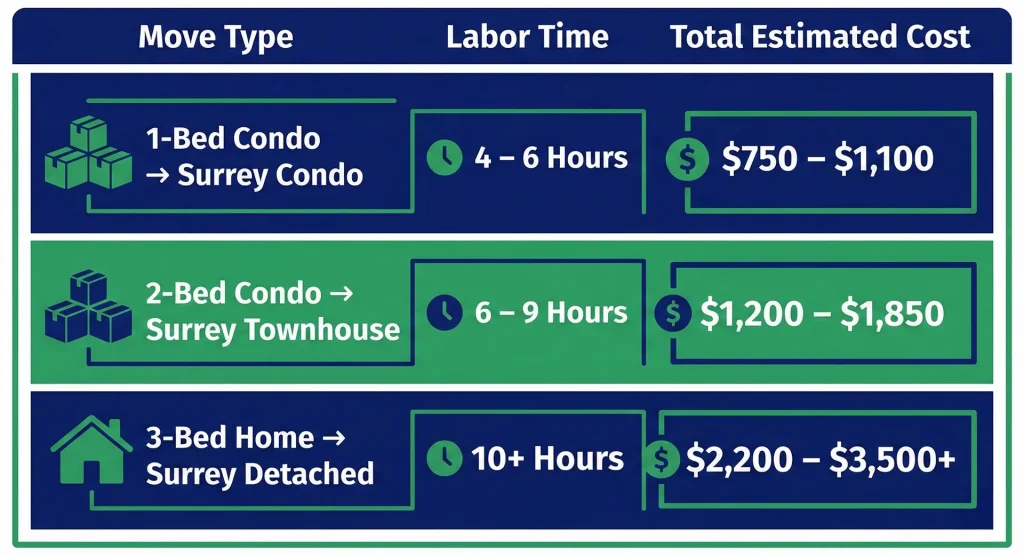
Pro Tip: For a Condo-to-Townhouse move, ensure you mention if your new Surrey townhouse has multiple flights of stairs. Movers charge for the physical effort, and three floors of stairs can slow down the unloading process significantly.
Choosing the Right Vancouver to Surrey Movers
Why Experience with Cross-City Moves Matters
Moving from Vancouver to Surrey isn’t a simple “point A to point B” job. It requires a team that understands the logistical nightmare of crossing the Fraser River during peak hours. Experienced movers know how to time the commute so you aren’t paying for three hours of labor while the truck sits in Massey Tunnel or Alex Fraser traffic.
Condo Bylaws and Building Coordination
Vancouver moves are heavily dictated by strict condo rules. A Professional Moving Company will:
- Navigate Bylaws: They understand the “Move-in/Move-out” fee structures and strict time windows (often 9 AM – 4 PM).
- Building Coordination: They handle the paperwork, like providing the Certificate of Insurance (COI) required by your strata to even allow the truck onto the property.
- Equipment: They bring the right dollies and padding to ensure no damage occurs to elevators or hallways, protecting you from losing your damage deposit.
Best Time to Move from Vancouver to Surrey in 2026

Timing is everything. Summer (May–September) is peak season; demand is high, and rates often spike by 20%. If you want to save, aim for a Winter move (January–March). While the weather is trickier, moving companies are hungrier for work and offer much more competitive rates.
Booking Movers and Planning Ahead
In 2026, the best movers book up fast. Aim to book at least 4–6 weeks in advance. To slash costs, choose a mid-month, mid-week date. Most people move on the 1st or 15th; avoiding these “transaction days” can save you hundreds in “peak-day” surcharges.
Is Moving from Vancouver to Surrey Worth It for Families and Future Planning?
For families, the move to Surrey is often less about leaving Vancouver and more about “upgrading” their lifestyle. In 2026, Surrey’s appeal lies in its balance of infrastructure and community feel.
Schools, Parks, and Family-Friendly Communities
Surrey is designed for growth. Neighborhoods like Fleetwood and South Surrey offer modern schools and large green spaces, such as Bear Creek Park. Unlike the concrete-heavy pockets of Vancouver, these areas provide kids with room to play safely outdoors.
Quieter Neighborhoods and Safer Living
While Vancouver deals with increasing urban density and noise, Surrey’s residential pockets offer a quieter, suburban peace. Dedicated cul-de-sacs and master-planned communities mean less through-traffic and a stronger “know-your-neighbor” atmosphere.
Long-Term Property Value and Investment Potential
With the SkyTrain expansion and Surrey’s status as a secondary downtown, property values are projected to climb steadily. Buying a townhouse here in 2026 isn’t just getting more space, it’s a strategic investment in one of BC’s fastest-growing economies, ensuring your family’s financial future is as stable as your home.
Final Decision: Should You Move from Vancouver to Surrey in 2026?
Choosing between Vancouver and Surrey in 2026 depends on your personal priorities. This move makes the most sense for growing families and remote professionals who need dedicated office space, private backyards, and financial breathing room.
Conversely, if your lifestyle thrives on downtown walkability, vibrant nightlife, and mountain views, staying in Vancouver’s dense core remains the better fit. Ultimately, moving from Vancouver to Surrey isn’t about giving up your lifestyle; it’s about reshaping it for long-term comfort and stability.
By trading a cramped condo for a spacious townhouse, you gain a tangible asset with high investment potential and a better overall balance between work, life, and value.
Frequently Asked Questions
Is Surrey cheaper than Vancouver in 2026?
Yes. On average, housing costs are 30-40% lower, and overall monthly expenses (groceries, parking, and insurance) are significantly more affordable in Surrey.
How long does it take to move from Vancouver to Surrey?
A typical move for a 2-bedroom home takes between 6 to 9 hours, including the 45-minute drive between cities, depending on traffic and elevator access.
Are Surrey townhouses a good investment?
Absolutely. With the Surrey-Langley SkyTrain expansion and massive population growth, townhouses in areas like Fleetwood and Clayton are seeing some of the strongest appreciation rates in BC.
Do movers handle condo restrictions?
Professional movers are experts at this. They coordinate with building managers, provide required insurance certificates, and work within strict elevator booking windows.
Testimonials

Love and Harsharan were Amazing. They showed up when they said, got right to work and didn't go over the time allotted. They were gentle with everything and very well mannered. 100% recommend. Thank you guys for making this move easy for us
- Marsha Widmeyer
Contact Us
"*" indicates required fields
Get access to a variety of moving and storage Canada solutions:

Contact Our team
Call Professional Movers Canada or fill out our free moving quote form.

Get Your Quote & Plan
Receive an obligation-free estimate and a detailed plan of action for your move.

Enjoy a Professional Move
Leave all the vexing tasks of relocation to our skilled Canada movers.